Guide 2 · Practice
IFS exercises you can do alone
Internal Family Systems is mostly practised in small, repeatable conversations with your own parts. These are the six that the Sunroom workbook walks people through, written out so you can do them with a notebook, with what each step is for and where to stop.
On this page
Before you begin: lanes, and the one question that keeps you safe
IFS work has two lanes. In the first you get to know your protectors, the managers and firefighters that run your days: what their jobs are, what they fear, what they would rather be doing. That lane is safe to travel alone, and it is where most of the change happens. In the second lane an exile, a young part carrying old pain, shows the Self what happened to it. That lane is for a trained IFS therapist, especially where trauma is involved. Every exercise below stays in the first lane on purpose, and each one tells you where its edge is.
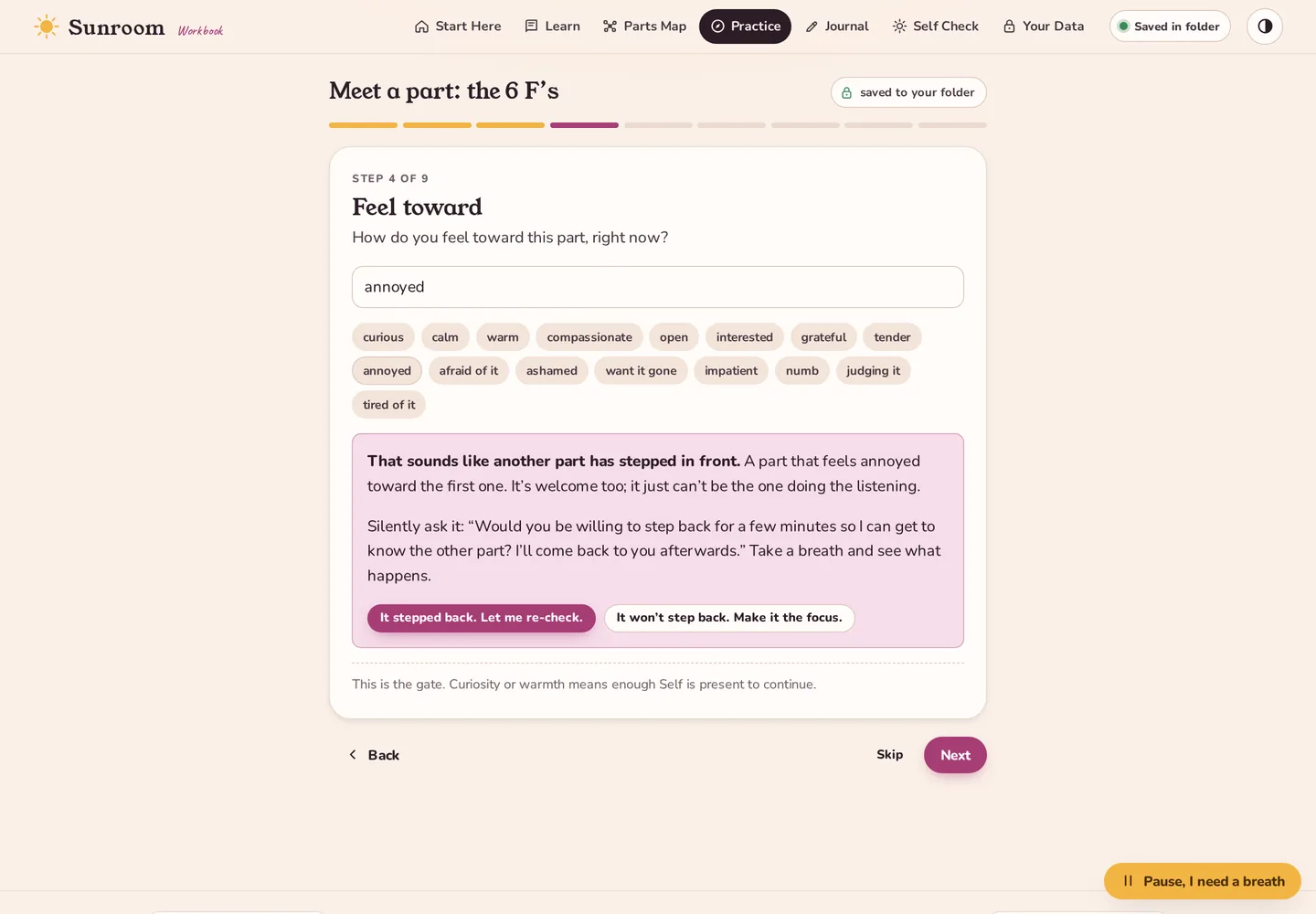
The question that keeps you in the right lane is the same in every exercise: “How do you feel toward this part?” If the honest answer is something like curious, calm, warm, compassionate, open, interested, grateful or tender, enough of the Self is present to continue. If the answer is annoyed, afraid of it, ashamed, impatient, numb, judging it, tired of it, or wanting it gone, that is not you talking; that is another part that has stepped in front. It is welcome too, it just cannot be the one doing the listening. Silently ask it: “Would you be willing to step back for a few minutes so I can get to know this other part? I’ll come back to you afterwards.” Take a breath, then ask the question again. If it will not step back, it has just become the part you are getting to know today. Nothing is lost.
1. Who’s here today? (5 minutes)
A short daily check-in. You are not choosing the most important part, only the one that is closest right now. Practitioners who teach this one generally agree that five minutes most days does more than an hour once a week.
- Arrive.Take three slower breaths. Let your attention drift inward, the way you would glance around a room to see who is in it.
A little settling gives the Self a chance to be the one who looks.
- Who wants attention?Notice which part is most present. It might be a familiar one from your map, or something new. Name it, or describe it in a few words.
- How does it show up?An image? A sensation somewhere in the body, such as a tightness under the ribs? A tone of voice, a temperature, an age?
- How do you feel toward it?Not what you think about it: what you feel toward it, right now. If the answer is not one of the C’s, ask the reacting part to step back, then check again.
- What does it want you to know?Ask, then wait. Answers come as words, pictures, or a shift in the body. Write whatever arrives, even “nothing yet.”
- What does it need from you?Today, or this week. Small is good: “to not be rushed this afternoon.”
- Thank it.Thank the part for showing up, tell it when you will check back, and ask whether anything else wants to be said before you stop.
2. Meet a part: the 6 F’s (15 minutes)
Find, Focus, Flesh out, Feel toward, beFriend, Fear: the standard sequence from IFS training for getting to know a protector. Steps one to three create a little separation between you and the part; step four is the gate; five and six build the relationship and reveal what the part is guarding. Pick a protector for this one, not a young part.
- Find.Which part needs your attention? A recent moment of being triggered is the easiest place to start: the reaction is the trailhead.
Finding means turning attention inward and noticing what is there: an emotion, a pattern, an impulse, a sensation.
- Focus.Stay with just this one part. Where in or around your body do you notice it? Jaw and shoulders, a hum behind the eyes? Let the other voices wait; you will come back to them.
Focus stabilises the part so it can be experienced rather than only thought about.
- Flesh it out.Is there an image? A shape, texture or temperature? An age, a voice? How close or far from you does it feel? If a picture or a photograph comes to mind that feels like this part, note it.
Asking about distance quietly starts unblending. If you can sense how close it is, you are already a little separate from it.
- Feel toward.How do you feel toward this part, right now?
This is the gate. Curiosity or warmth means enough Self is present to continue. Anything else is another part; ask it to step back and check again.
- Befriend: its job.Ask the part: What is your job? How did you get it? How long have you been doing it? Is it working? Write what it says in its own words. Then ask: if you did not have to do this job, what would you rather be doing?
Protectors soften visibly when they are finally asked instead of fought, and most of them are exhausted. The second question shows them a future.
- Fear.Ask: What are you afraid would happen if you stopped doing this? Who or what are you protecting?
The answer usually points to an exile or to a polarized part. That is the edge of today’s work. Note it; do not chase it.
- What it needs, and thanks.Ask what it would need from you to trust you a little more (“check in with me before big meetings”). Then appreciate it, sincerely, for how hard it has worked. Ask any part that stepped back whether it is okay with what happened, tell them when you will return, and bring your attention slowly back to the room.
3. Unblend in 60 seconds (2 minutes)
For the middle of a hard moment, when a part has taken over and there is no time for anything longer. The aim is a little space between you and the part, not calm.
- Name it as a part.Finish this sentence: “A part of me is…” furious, frozen, certain everyone is annoyed with me.
Language is the first lever. “I am” blends; “a part of me” separates.
- Find it in the body.Where do you feel it most? Chest, throat, hands? Just notice; no need to change anything.
- Ask for a little room.Silently say to the part: “I see you. Would you be willing to step back just a bit, so I can be with you instead of inside you? I’m not going anywhere.” Wait a few breaths.
It is a request, not a command. If it refuses, ask what it is worried would happen if it did.
- Check.Now, how do you feel toward it?
- Notice what shifted.Even a small change counts: the breath, a little distance, a thought that is not quite so certain anymore. “It’s more like it’s beside me than on me.”
- Thank it.Thank the part for giving you room, and tell it you will come back when things are calmer. Then do.
4. Two parts at a table (12 minutes)
For a tug-of-war: the driver and the “why bother,” the pleaser and the resentful one, the dieter and the binger. Polarized parts escalate in response to each other, so neither can reach the Self. The move is to let each one speak to you, not at the other.
- Pick the first part.One side of the tug-of-war, for instance the one that pushes.
- Pick the other part.The one that pulls the other way.
- Set the table.Imagine both parts seated at a table with you at the head. Each will speak to you, not to the other. Your job is mediator, not judge.
- The first part speaks.Ask it: What are you trying to do for me? What worries you about the other part? What are you afraid would happen if you softened? Write its answers.
- The other part speaks.The same questions. Let it be just as heard.
- How do you feel toward them both?Take a breath and check. Ask any third part that has an opinion to wait its turn.
- What do they share?Often both are protecting the same tender thing in different ways. What might they have in common? What does each value in the other, if anything?
- What each needs from you.Ask each what it would need in order to trust you to lead, so that neither has to be so extreme. Then thank both, tell them you will come back, and say plainly that neither has to win for the system to be okay.
5. Fire drill: rehearse a trigger (10 minutes)
Before a hard conversation or event, meet the parts that will brace for it and ask them to let the Self lead. This is an adaptation of one of Richard Schwartz’s guided exercises, and it is the one people most often report using in real life.
- Name the situation.What is coming up that you expect to be difficult? “The review on Thursday.”
- Watch from outside the room.Imagine the situation happening in a room while you stand just outside, watching through a window. Notice what happens in your body as you watch.
Distance lets you see the parts react without being swept up by them.
- Who braces?Which parts jump up? Name each one and what it wants to do: argue, freeze, please, leave.
- Their worries.Ask each part what it is worried will happen in there. Write the worries down without arguing with them.
- Ask them to let you lead.Tell the parts: “I hear you. Would you be willing to stay here by the window and watch me handle it? If it goes badly, you can jump in.” Wait for their answer.
- Walk in as Self.Now imagine entering and handling the situation with the parts watching. What is different about how you speak, breathe and listen?
- Debrief with the parts.Ask how it was for them to watch. Thank them. Agree on a small signal you can use in the real moment, a hand on the sternum or a slow exhale, to remind them you are there.
6. Coming into Self (3 minutes)
A breathing minute and a quick scan for the body signs of Self. Good on its own, and the right place to start before any of the longer exercises.
- Breathe.In for four, hold for two, out for four, for about a minute. Let your parts take a seat around you. Nothing has to be fixed right now.
- How much space?On a scale of 0 to 5, how much room is there between you and whatever was loudest a minute ago?
- Body markers.Any signs of Self? An open chest, slower breath, a relaxed face, spaciousness, a sense of having no agenda.
- Carry it.Thank the parts for the quiet. If you are about to do a deeper exercise, this is a good place to start from.
Making it stick
Three habits make the difference between having read about IFS and practising it. Anchor the check-in to something you already do: the first coffee, the walk, the moment before sleep. Write the answers down, in the part’s own words, and date them; a part that said “I started when you were nine” in March is worth re-reading in June. And go back. Parts notice when they are remembered, and a protector that was asked its job once and then ignored learns exactly what it expected to learn. In Sunroom every exercise files itself into a journal tagged by part, and the answers land on the part’s profile, so the going back is built in; a notebook with a page per part does the same job.
Stop for the day when a young part floods you, when you notice you are arguing with a part instead of listening to it, or when the feel-toward question keeps coming back with “want it gone.” None of those are failures; all of them are information, and the last two usually mean the next part to get to know is the one that is objecting.