Guide 1 · Parts mapping
How to map your parts
An IFS parts map puts your inner system on one page: the Self in the middle, your parts around it, and lines for who protects whom. Here is how to make one, what to put on it, and how to read it once it is in front of you.
On this page
What a parts map is (and what it isn’t)
In Internal Family Systems, the mind is understood as a system of parts, each with its own feelings, beliefs and job, gathered around a core Self that can lead them. A parts map is the simplest possible picture of that system: one page, Self in the centre, each part you have met so far placed somewhere around it, and a few lines for the relationships between them. It is the IFS equivalent of drawing a family tree before you try to understand a family.
A parts map is not a diagnosis, a personality test, or a finished product. Two parts is a valid map. The version you draw tonight will be wrong in a month, which is exactly the point: a map you redraw over time shows you something no single session can, which is how your system moves. Parts drift closer to the Self as they learn to trust it. Protectors relax. A part you never noticed turns out to have been running the whole show.
The three roles, in a minute
Most parts fall into one of three roles, and knowing them makes the map draw itself. Managers work in advance: they plan, please, criticise, organise and control so that old pain never gets touched. Firefighters react after the fact: when pain breaks through anyway, they put out the fire by any means available, from scrolling and snacking to rage and shutting down. Exiles are the young parts carrying the pain the other two are organised around; they are kept out of sight, and they want, more than anything, to be seen. Managers and firefighters together are the protectors. Every part, whatever it does, has a positive intention underneath. If you want the longer version of any of these, the glossary has it.
What you need
A sheet of paper and a pen, or a stack of sticky notes and a wall. Twenty quiet minutes. If you use Sunroom, the Parts Map chapter is the same exercise with stickers you can drag, a profile card for each part, and a date stamp on every version; the screenshots below come from it. Nothing here requires it.
Eight steps to a first map
- Put the Self in the middle.Draw a circle in the centre of the page and write “Self” in it. This is you at your calmest and most curious, the one who will be doing the looking. Everything else on the page is a part.
In IFS the Self is not a part; it is what remains when the parts step back. Starting with it on the page keeps that distinction in view.
- Start from a trailhead.Think of a recent moment when your reaction was bigger than the situation: the flash of anger at a small remark, the three hours that vanished into a screen, the apology you made for something that wasn’t yours. That reaction is a trailhead, and at the end of it is a part.
You are not trying to list every part you have. You are finding the one that is closest right now.
- Give it a name it would accept.“The Planner.” “The Critic.” “The One Who Goes Quiet.” Names in IFS are descriptions of a job, not insults; a part called “My Laziness” will not talk to you, and one called “The Part That Needs Rest” might. If nothing comes, borrow from the usual suspects: the inner critic, the perfectionist, the people-pleaser, the taskmaster, the scroller, the lonely one.
- Place it on the map.Managers tend to gather at the top, firefighters to the side, exiles low down, and there should be an honest corner for “not sure yet.” Then decide the distance from the Self: a part that is on top of you most days, whose opinions feel like your own, sits close; a part you can observe with a little room sits further out.
Distance is the quiet part of the exercise. If you can sense how close a part is, you are already slightly separate from it, which is the beginning of unblending. Size is the other quiet part: on Sunroom’s map a part that looms can be drawn at twice the usual size and a shy one at half, and watching that change over time says as much as the distance does.
- Fill in its card.Beside the part, or on its sticky note, jot what you know: where it lives in the body (jaw, chest, behind the eyes), how old it seems, what its job is and how long it has been doing it, what it is afraid would happen if it stopped, and what it seems to be protecting. Leave blanks. Blanks are questions for later.
- Draw the lines.Three kinds cover almost everything. Protects: a line from a protector to the part it guards, usually an exile. Polarized: two parts pulling in opposite directions, each certain it must balance the other, such as the driver and the “why bother,” or the dieter and the binger. Allied: parts that work together toward the same goal.
- Step back and look at the whole thing.Hold the page at arm’s length. Where is it crowded? Which part has no lines at all? Which one did you almost leave off? Who is closest to the Self, and is that the part you would have guessed?
- Date it and come back.Write today’s date in the corner. Next month, draw it again without looking at the old one, then compare. The differences are the story.
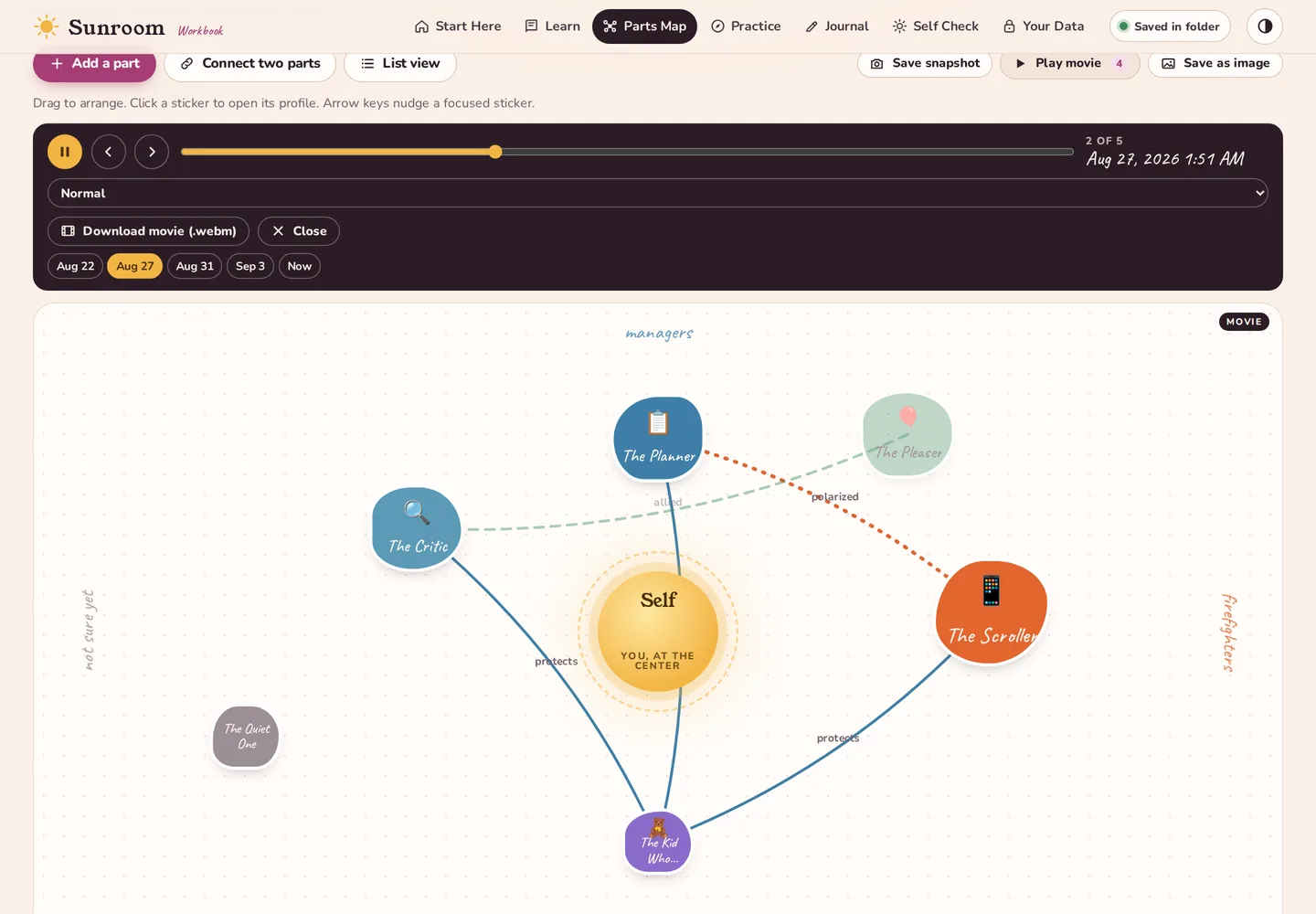
In Sunroom this step is a button: Save snapshot stamps the map with the date, and Play movie animates every snapshot into a time-lapse that ends at today.
An example system
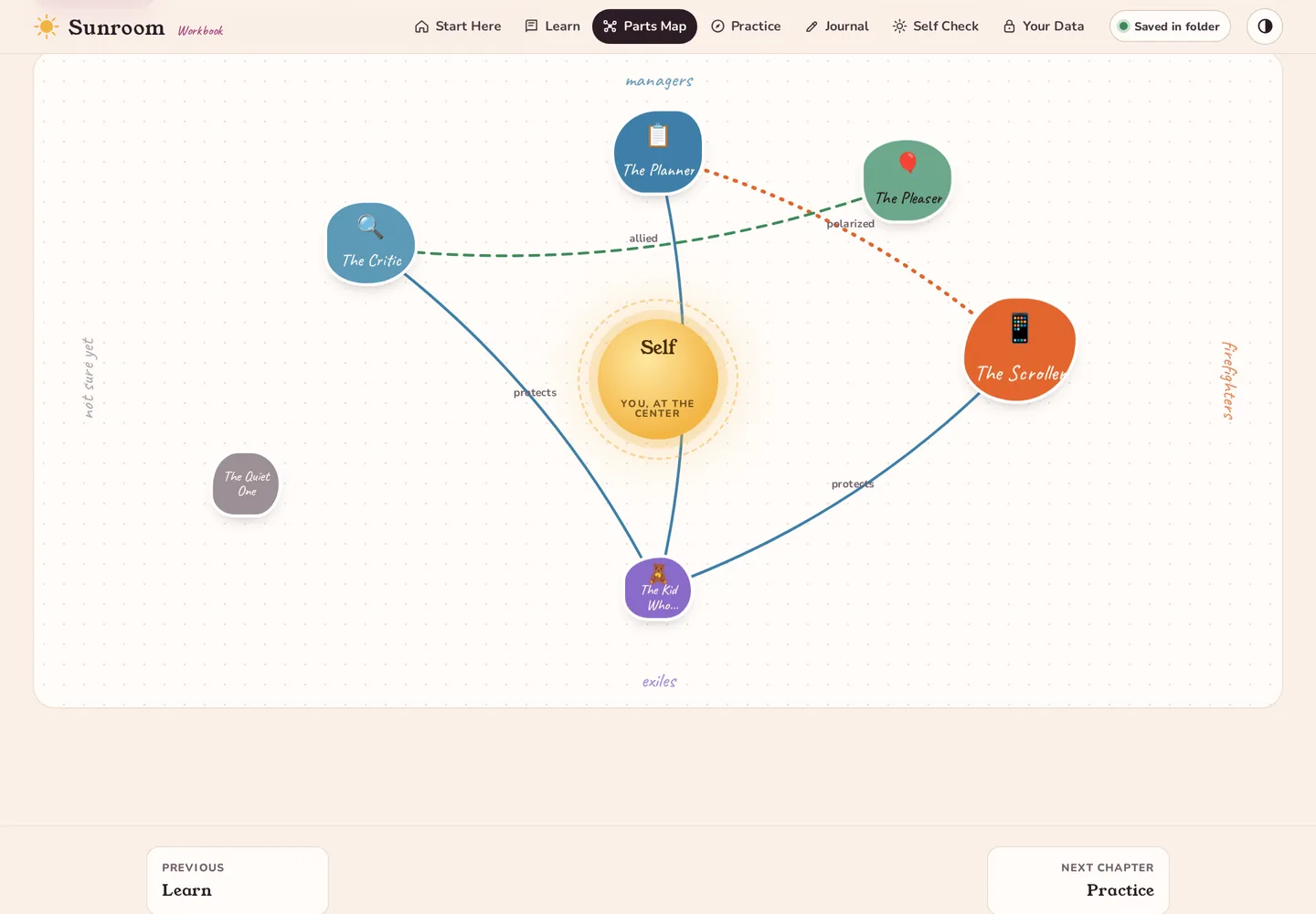
This is the example system the workbook loads when the map is empty, and it is a fair picture of how first maps look. The Planner (a manager, about thirty, felt in the forehead and shoulders) keeps three steps ahead so nothing catches us off guard; it is afraid that if it stopped, something would go wrong and it would be our fault. The Critic (a manager, teenage, a voice just behind the left ear) points out flaws before anyone else can, so that we are never humiliated in public. The Scroller (a firefighter, no age, just fast, restless hands) makes the evening disappear when a feeling gets too close, because it is sure the heavy feeling would swallow everything. All three protect The Kid Who Waits, an exile of about six, a heaviness low in the belly, who holds the memory of waiting for someone who was late and is afraid of being left again. The Quiet One sits in the not-sure corner with nothing on its card yet, which is fine.
Notice the one dotted line: The Planner and The Scroller are polarized. The more the Planner drives, the harder the Scroller has to pull the plug at night; the more evenings vanish, the more the Planner panics in the morning. Neither is the problem. Both are guarding the same six-year-old.
Reading your map
Once it is in front of you, a map answers questions you did not know to ask. A crowded top means a lot of managing: a life run so nothing gets triggered, at the cost of a great deal of energy. A protector and a firefighter tied to the same exile are usually polarized, even if you have not drawn the dotted line yet; the manager works to prevent the feeling and the firefighter works to kill it once it arrives. A part with no lines is either new to you or doing a job you have not asked about yet. The part you almost left off is worth a second look; the parts we avoid mapping are often the ones running the most behaviour. And whoever sits closest to the Self is the part you are most blended with, which is not the same as the part you like most.
It also helps to read the map in the other direction: from each exile outward. How many protectors does one young part have? What would happen to all of them if it were finally heard? That is the long game of IFS, and the map shows you the shape of it before you have taken a single step.
Common mistakes
- Mapping the parts you think you should have. Map the ones that showed up this week, not a textbook system.
- Judging while you draw. If you notice contempt for a part as you write its name, that contempt is another part talking. Note it, add it to the map, and carry on.
- Doing the whole system at once. Three parts, well described, beat fifteen names with nothing beside them.
- Treating the map as permanent. It is a photograph, not a portrait. Date it and expect it to change.
- Heading straight for the exiles. The young parts at the bottom of the page are the most important and the least ready. Get to know their protectors first; that is what the lines are for.
Doing it safely on your own
Mapping is a protector-level exercise: naming, placing and describing the parts that run your days. That is safe to do alone and it is where most of the benefit is. The deeper work, in which an exile shows the Self what happened to it, belongs with a trained IFS therapist, especially where trauma is involved. If a young part floods you while you are drawing, stop, put both feet on the floor, name five things you can see, and tell the part you see it and will come back with help. In the US, call or text 988 in a crisis.
Paper or screen?
Paper is good, and many people never need anything else. What a screen adds is motion. On paper a part that has relaxed needs a new drawing; on a map you can drag, you move it an inch closer to the Self and the change is recorded. A profile that grows with every exercise, connections you can retype, a gallery of pictures that feel like a part, and a dated snapshot each time something shifts: those are the things Sunroom’s map does that a page cannot, and the movie that plays them back is the reason it exists.